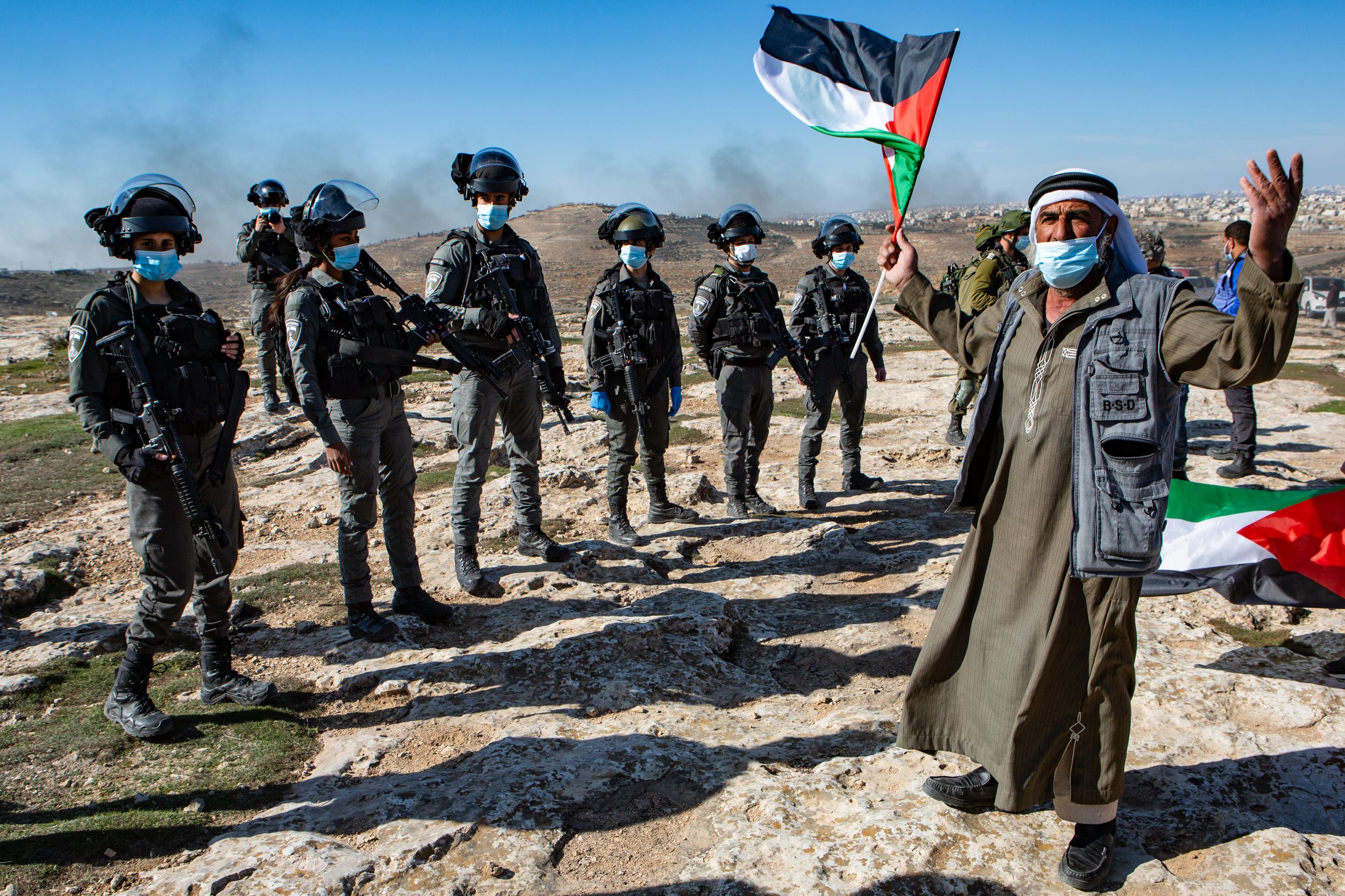
Confronting occupation
-
Awdah Al-Hathaleen, 27, Umm al-Khair, Palestinian human rights activist & English teacher
“You can either be a peace and human rights activist or you can put all your feelings aside and not care about anything. Based on my own experiences and the stories I hear from our elders, I went with the first option. I reached the conclusion that our problem is with the Zionists - not with those people who believe in our rights. Every day here there are [Israeli] attacks and resistance and we of course want the world to know what is going on. We don’t have any other choice.
”By the way, you just asked me why I became a human rights activist: So, you heard that dog barking in the background? An Israeli settler just passed through the very center of our village with his dog. This is what I mean when I said we don’t have any other choice but to be activists.“
Awdah Al-Hathaleen, 27, Umm al-Khair, Palestinian human rights activist & English teacher:
“We respect all religions… We welcome everyone and we would never tell anyone to take off their kippah or something. But to be honest, for many people there are very negative associations with Jewish ritual symbols because of the settlers. The settlers have created a very bad impression for us of the kippah, as they wear them during their attacks. So some of us still don’t like to see this in the village.”
-
Bob Suberi, 72, St. Louis, Missouri, American Jewish activist:
“They are vicious and twisted, and I’ve seen some things that really makes me wonder where Judaism is going if it allows these activities and the perception that we are so good, so superior, that we can treat human beings the way we treat Palestinians. That we can raise our kids to throw stones at their elders. Jewish kids treat these kids like they are trash, like they are insects that need to be crushed. It’s that bad, and I’m not exaggerating. It’s not something that I can really wrap my head around, and it’s not something I would even attempt to try to change because I wouldn’t know where to start, you know? It’s been shocking. It’s shocking to see.
“But being here with Hineinu [the Center for Jewish Nonviolence’s extended program for Diaspora Jews in the South Hebron Hills] and living with Palestinians and seeing how they deal with this and raise their kids - they are happy kids, they are fun, they are animated, they are curious. They welcome us. We’re not the enemy. They don’t treat us like the enemy. You can’t wrap your head around it but you can feel it in your heart that these people are exceptional in their perseverance - what they call sumud.”

Bob Suberi, 72, St. Louis, Missouri, American Jewish activist
“I had never really considered Palestinian people, and who they were and that they even existed. They were so completely erased from the histories that I’d read. So I wanted to meet Palestinians; I wanted to see for myself. So I came and it was a very worthwhile experience. We came to the South Hebron Hills and visited several different Palestinian villages and met people. They were not what I had imagined: they had a culture, they had values, they had needs. They had land that they don’t have anymore. It’s taken me quite a while to absorb the fact that this was a living, vibrant country… that was colonized. The indigenous inhabitants have been so completely erased - unless you start looking. But if you just go to Israel, they have just been erased.”
Sarah Brammer-Shlay, 30, Philadelphia, Pennsylvania, American Jewish activist & rabbinical student:
“After I was assaulted [by Israeli Border Police officers who broke my arm] in 2017, I’ve done a lot of reflection about what it means to have spiritual and emotional support built into organizing spaces as opposed to just being there as a reaction… It’s very important to have a regular support system built in because sometimes people need the support not the very next day but like two months down the line. Sometimes when you are in crisis mode, you just have to survive. That’s classic fight/flight/freeze mode - you just gotta get through it. So when activists are there for three or four months, they don’t necessarily have the space [to process]. This is obviously true for Palestinians living there. How are they supposed to create space for all the intense things they are experiencing in their communities when it’s continuous?